Last month a plumber rang me from Morningside, a bit cranky.
He’d booked a full-size vac truck to find a water service and a sewer junction at the front of a house. Two holes. Maybe a wheelbarrow of dirt between them. The truck turned up, couldn’t get into the street because of parked cars and a council tree hanging low over the road, and ended up double-parked at the corner with hose running 30 metres back along the footpath. He paid for half a day of big truck to dig two holes a trailer would’ve knocked over before morning tea.
The week before, I’d heard the opposite story. A civil crew up near North Lakes grabbed a vac trailer to pothole a run of services for a new driveway crossing and some conduit. Eighteen holes in clay. The trailer was full by about 9.30, the water tank ran dry not long after, and they spent the day shuttling between the site, the tip and a hydrant. They finished on day three. A truck would’ve done it in one.
Neither of those crews made a dumb choice, exactly. They just didn’t think about the job before they picked the gear.
So here’s how I’d work it out.
What you’re really choosing between
A vacuum trailer is a towed unit. You’ve got a small spoil tank, a small water tank, an engine driving the vacuum and the water pump, all on a trailer you hook behind a ute. Sizes vary a lot, but you’re usually looking at a spoil tank somewhere under a couple of thousand litres, and often a fair bit less.
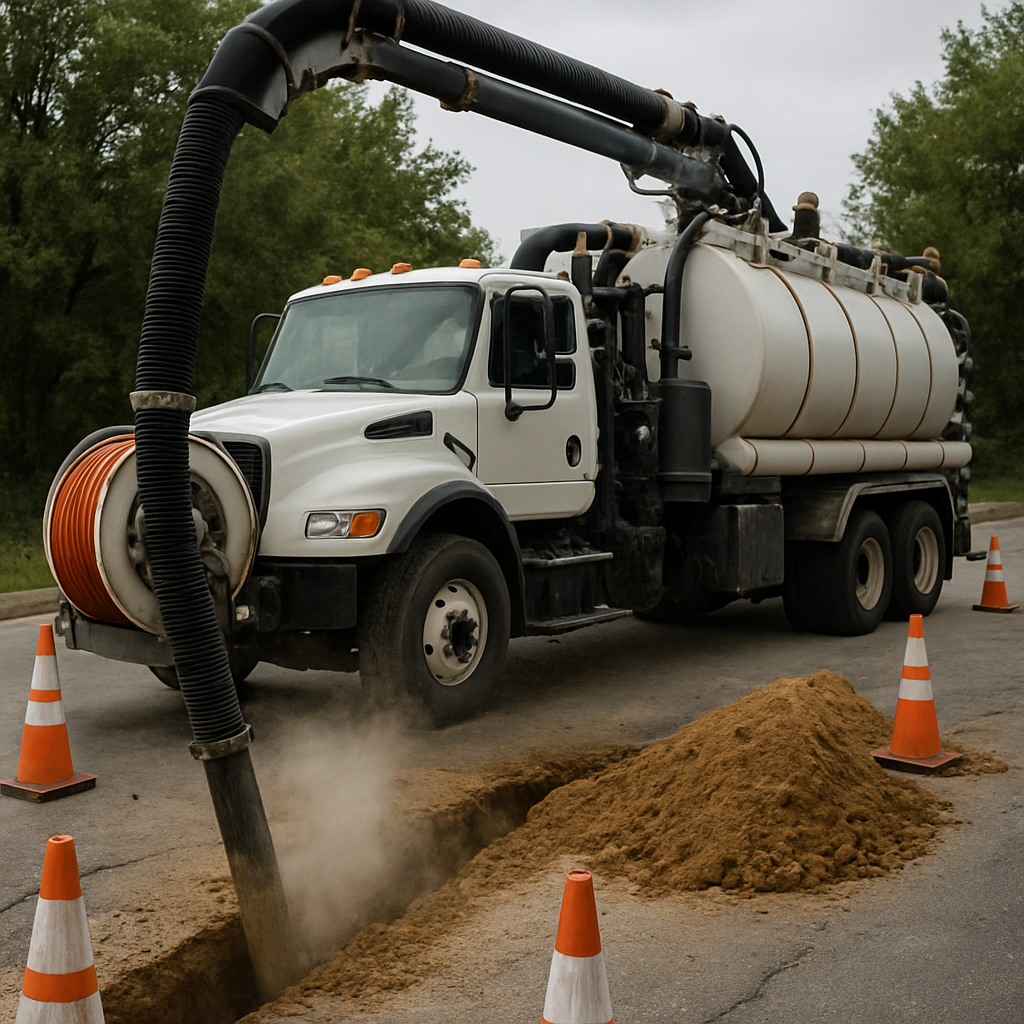
A vacuum truck is the whole thing built onto a truck chassis. Bigger blower, bigger spoil tank, a lot more water on board, wider hose, and much more grunt. Spoil tanks run anywhere from around four thousand litres to well over ten on the big civil units.
That gap in size flows through to everything else. How fast you dig, how long you can go before emptying, where you can park, who can drive it, and what it costs you by the end of the day.
Suction and speed
This is the bit people underestimate.
A truck pulls a lot more air. More air means it lifts heavy, wet Brisbane clay faster, keeps sucking strongly further down the hose, and doesn’t choke as easily on gravel and chunks. Trucks usually run a fatter hose too, so more material moves per minute.
A trailer will dig the same hole. It’ll just take longer, especially in sticky clay or once you get a bit of depth. And it loses suction faster over distance. Run a long hose off a trailer, add a couple of bends and a bit of uphill, and you’ll feel it drop right off.
On a single pothole, who cares. Ten minutes either way. On twenty holes, or 30 metres of trench, those minutes stack up into hours.
Water runs out quicker than you think
If you’re running hydro, you’re using water the whole time you’re cutting. Trailers carry a fraction of what a truck does.
On a small residential job that’s fine. Fill up in the morning, dig your holes, done. On anything bigger, the water tank is often what stops the trailer, not the spoil tank. Then you need a refill, which means a tap on site you’re allowed to use, or a hydrant standpipe with the right approval from the water authority. Don’t just crack a hydrant open on the street. That ends badly.
Trucks carry enough water for a solid day on most jobs, so you’re not stopping to chase it.
If you’ve got an air vac trailer, the water problem mostly goes away. You’re also slower in heavy clay, though, so it’s a trade.
Spoil volume and the tip run
Every time the tank fills, the digging stops.
With a trailer, that happens a lot sooner. If the disposal facility is 15 minutes away and you’re only filling it once, no drama. If you’re filling it three or four times a day and the tip’s 40 minutes away in afternoon traffic, you’ve just turned a digging day into a driving day.
Hydro slurry can’t go down the stormwater or into a skip, whichever unit you use. It’s going to a licensed facility either way. The only question is how many trips it takes to get there.
Quick way to think about it: work out roughly how much dirt is coming out, including water if it’s hydro, because slurry takes up more room than the dirt did. If that’s more than one trailer load, ask yourself whether you want to be making those trips. Most of the time on a bigger job, you don’t.
Parking, access and getting the thing there
This is where the trailer earns its keep.
A ute and trailer can get into places a truck simply can’t:
- Narrow streets in Paddington, Red Hill or Spring Hill with cars parked both sides
- Cul-de-sacs where a truck can’t turn around
- Steep driveways in The Gap or Bardon
- Shopping centre and unit complex car parks with tight turns
- Sites where a heavy truck would crack the driveway or rut the verge
On some jobs you can unhitch the trailer and position it right near the dig, sometimes even up a driveway or onto a hardstand. That cuts your hose run way down, which claws back some of the suction you lose by not having a truck. A short hose off a trailer can beat a very long hose off a truck.
Trucks need room. They need solid ground under them, especially once they’re loaded up. They need clearance under trees, powerlines and car park height bars. They often need a traffic management plan if they’re sitting on a busy road. None of that is a deal breaker on a civil site, but on a tight residential street it can be.
One more thing. Most vac trucks need a medium or heavy rigid licence. A trailer just needs a ute that’s rated to tow it, with the loaded weight sitting inside the ute’s towing capacity and the tow bar’s rating. Check the actual numbers on both. A full trailer is heavy, and plenty of people overload their ute without realising.
Where a trailer makes more sense
I’d send a trailer for:
- One to a handful of potholes to find a water service, sewer junction, gas meter line or NBN lead-in
- Residential plumbing work, like exposing a connection before a repair or upgrade
- Small pier holes where there’s a service nearby you need to see
- Valve, pit and meter exposure for councils, body corporates and maintenance crews
- Tight streets and small sites where a truck would block the road or can’t get in
- Light cleanout work like small pits and drains
Picture a plumber in Kedron chasing a leak on the water service under the front lawn. One hole, maybe two. Ute and trailer pulls up, unhitches in the driveway, digs to the pipe, fixes, backfills, gone by lunch. Sending a truck there is like turning up to a bin pickup with a semi.
Where a truck is the better call
I’d send a truck for:
- Trenching longer than a few metres, especially in clay
- Civil jobs with service exposure along a road reserve or conduit alignment
- Lots of potholes in a day, like a directional drilling job with crossings all along the run
- Higher spoil volumes, such as deeper pits and bigger holes
- Long hose runs where you need the extra suction to keep moving
- Any job where a machine or a drill rig is waiting on you
That last one matters more than people think. On a lot of civil work, the vac truck isn’t the expensive part. The excavator, the drill rig, the crew and the traffic control all standing around waiting for clearance are the expensive part. If a trailer slows you down by half a day, you’re paying for all of them too.
Take a conduit run along a road reserve out at Rocklea with a dozen crossings to expose. A truck works through them steadily, empties maybe once, and the machine follows behind. A trailer does three or four holes, goes to the tip, comes back, chases water, does a few more. The drill crew’s on their phones for most of the afternoon.
Overbooking the truck
This happens a lot, mostly because people think bigger is safer.
It isn’t. A truck on a small job is:
- More expensive per hour for no extra benefit
- Harder to park, so you often end up with a longer hose run anyway
- Heavier on driveways, verges and old concrete
- More likely to need traffic control on a residential street
- More likely to annoy the neighbours
If the job is a few holes and not much dirt, you’re paying for capacity you’ll never touch.
Underbooking the trailer
The other trap is grabbing a trailer because it’s cheaper per hour or it was the only thing free.
Then the job turns out to be bigger than everyone said. “Just a couple of holes” becomes eight. “Short trench” becomes 25 metres. The trailer fills, runs out of water, struggles on a long hose run, and the day disappears.
On paper, the trailer rate looked better. Add up the extra hours, the tip runs, the water refills, the fuel and the crew waiting around, and it usually isn’t.
Be honest about the size of the job when you book. If it might grow, say so.
Wet hire or dry hire
Trailers get dry hired a lot, because anyone with a suitable ute can tow one away. That’s handy for maintenance crews and plumbers doing routine exposure work, as long as the person on the wand knows what they’re doing.
Trucks are more often wet hired. Partly because of the licence, and partly because of the work they do.
Either way, the same rule applies. If you’re digging near gas, HV, fibre or pressurised mains, the operator matters more than the gear. High-pressure water too close to a poly gas service will cut it, trailer or truck. A small unit doesn’t make it a safe unit. If your crew doesn’t do this every week, get someone experienced on the wand.
And do the basics no matter what you hire. Lodge your Before You Dig Australia enquiry, read the asset owner conditions that come back, and ask the property owner what’s been put in over the years.
How I’d decide
Before booking, answer these honestly:
- How many holes, or how many metres of trench?
- What’s the ground? Sandy loam is easy. Heavy clay is slow. Rock is a different conversation.
- How much spoil, including water? One trailer load or several?
- Where’s the nearest disposal facility, and what’s traffic like at that time of day?
- Can a truck physically get there and park safely?
- How far is the dig from where the unit will sit?
- Is anyone waiting on you? A machine, a drill rig, other trades?
- Have you got water on site, or a legal way to refill?
If it’s small, tight and quick, get the trailer. If it’s big, long or holding up other people, get the truck. If you’re stuck in the middle, ring a couple of operators, give them the real numbers and ask what they’d send and why.
The good ones will tell you straight, even if it means you hire the cheaper unit. I’d trust that crew over the one that just says yes to whatever you asked for.